We made it! It is spring break! Please take this time to RELAX & RECHARGE after giving so much to our students and families at PVES. Below you will find some ideas to relax and recharge your teacher soul!
Welcome to week 8 in quarter 3! This week, I would like to investigate critical thinking in grades K-3. When a student uses critical thinking, they are wondering, making connections, and interacting with new vocabulary. Critical thinking is when a thinker analyzes, assesses, and breaks apart a topic to better understand it. This comes easily to some learners but others need more modeling. Below you will find videos, suggested blog posts, and freebies to help support critical thinking in your classroom.
Watch this video from Oxford Discover: How to use Critical Thinking
How to improve critical thinking?
Let's watch this video from:
TedED & Samantha Agoos.
Heidi's Songs has some very simple ways to increase critical thinking with young learners.
Click the image to visit her site:
More ideas for the classroom:
Mystery Box
Use a mystery box to introduce new ideas for the classroom & support inferencing!
A Mystery Box is a great way to introduce a science concept or a theme. Students could even create their own mystery boxes for research projects. I also like to use this idea to help students learn to make inferences. Show them the contents of the box and encourage them to make inferences about the connections between the objects.
Read more about:
The Inspired Apple
Teach problem-solving with wordless videos!
Wordless picture books and videos are perfect for getting the brain thinking and analyzing.
Visit Speech is Beautiful for some awesome videos to get your students critically thinking!
Learn to add depth and complexity to your lessons by visiting Melissa over at Teacher Thrive.
Grab her FREE Critical Thining Cheat Sheets and bookmarks.
Did you know you have access to an online science textbook on Discovery ED? Well, you do and it is awesome! Check out this video below. It walks you through all DE has to offer within their textbook.
Science can easily be integrated into your reading lessons through balanced literacy. Nonfiction leads itself to shared reading and close reading activities. Check out how Mrs. Richardson's class makes this happen over oh the blog!
Don't forget all the great options for integration that are offered on RazKids and Reading A to Z! You can assign texts for students & use projectiable books. Epic Books is another great site to visit. You can create collections on topics for your students to read on their own or use the book on the smartboard for whole group. Don't forget that you can create quizzes to help support comprehension!
Using a fiction book study to lead into a nonfiction unit of study is a great way to build background knowledge to support connections and engagement. Thundercake by Patricia Pollacco is a great book to introduce a weather unit!
Head into Epic and build a collection of book on thunderstorms!
Jump into your DE Science Textbook!
Students can also go into DE Board Builder and create a board all about thunderstorms to demonstrate what they have learned.
Your budding scientists can participate in science experiments like how to track a storm.
In the fiction book, the characters count in between lightning & thunder to determine the location of the storm. Students could use a simple lamp and the sheet below!
They can watch a video on DE for how to track a storm.
See how science, reading, and art can be integrated too!
Welcome to Week 6 in Q3! I wanted to take some time and look at ways to keep our math lessons hand on and engaging! Hands on learning keeps learning real & brings the concept to life for students. That connection is one that stays with a student and allows the learner to draw upon it during future learning. Students are more focused because they are learning from an experience. That experience is tapping into many different learning styles to solve the problem. Read 4 Reasons to Use Manipulatives, Not Just in Math! From We Are Teachers!
What is a Cheese Bit? I love this math video from Making Math Real. In the video the instructor models and explains how to move from concrete to abstract. Watch The Story of Three! and see the Cheese Bits in action!
SILLY NUMBERS! I love how he helps the students understand that 20 14 is really 34. Such a great way to get students into renaming numbers.
This visual is a simple way to represent the idea of concrete to abstract.
Students need the foundation of concrete (Manipulatives) to understand the abstract (Algorithm).
So before you plan your next week of math think about CRA! How can you hit those learners and help them as they cross the CRA continuum?
This week, let's examine the idea of share writing. Too often our schedules don't allow much time for writing instruction. In a strong Balanced Literacy classroom, you will find both reading and writing instruction taking place. I wanted to take this blogpost into the world of shared writing. Shared Writing is a time in the classroom where the teacher acts as a guide in modeling and shaping language for students. The students and teacher work together to create a piece of writing. It is especially important for our struggling readers and ELL students to engage in shared writing. Shared writing allows students the opportunity to express their thinking orally first and then to be able to see it in written form modeled by the teacher. Check out this article Must Know Tips for Shared Writing written by Regie Routman to gain some insight on strategies for shared writing.
The video below is a good example of how a teacher can engage in shared writing & sharing the pen with their students.
One of my favorite shared writing activities is morning message. This can be used in all grades! Students love to come into to a message or to watch as a teacher constructs a message. Check out a morning message in 3rd grade below!
I love they way this teacher using call and response plus her word wall to guide students during a morning message. They always LOVE when you make mistakes and they catch you. Wink, wink!
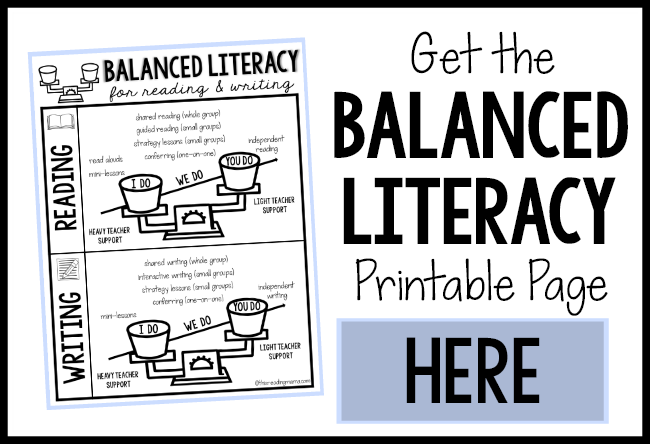
Grab a FREE copy of this Balanced Literacy infographic from The Reading Mama! It is a great visual for how teachers and students work together in a Balanced Literacy classroom!
You can also check out Light a Fire below for more ways to motivate your students.
Or download this FREE class survey to help you determine how your class is motivated.
For me, the most powerful way to motivate students is to allow them to take ownership of the classroom. That leads over into ownership of their learning. Students need to feel safe to make mistakes within their school family. That security is what supports their learning goals.
That is why morning meeting is so important. It is a time for students to learn to lead, make connections, and problem solve. We so often want to forgo this time to jump right into instruction. If this happens and those connections are not made we put a limit on our learning potential.
Are you teaching GRIT?
I LOVE these motivational videos made by students.
It would be awesome to have your students create motivational videos for each other.
Check out this motivational story about two seeds!
And this funny one too!
Ways to motivate using words!
Rewards: If you are looking for some easy and inexpensive rewards for your students, click below to head to Pinterest!
This week, I wanted to share some ideas to get your students excited about writing about reading. I am a firm believer that students should not be exclusively answering written comprehension questions as their only written response for reading. Students should be writing beforereading, duringreading, and after reading. I am going to break this idea up into sections and give you simple ways to get your students engaged in written response.
(The more you get them writing about their OWN thinking, the more comfortable they will become responding to texts.)
Pre Reading Writing: Activate Prior Knowledge Prediction Writing-Students can look at the cover of a book and write a prediction on post its. (Project the cover of the book on the smartboard.) Have them add those post its to a chart paper poster about the story. Be sure to revisit the poster during and after reading to discuss the predictions. Check out these fun and engaging ideas from The Lemonade Stand!
Or use this FREE writing sheet from JD's Rockin' Readers! KWL: So GREAT for nonfiction! I think I used this every time I introduced a nonfiction text. You can have some serious fun creating a HUGE one for your class and then a smaller one for your students to write on. Here is one from my nonfiction unit on Sharks! Just be sure to revisit it during and after reading!
Table Top Twitter: Pose a question related to a book that you will be using in class. Cover tables with paper and allow students to answer the question on the table. This would work for predictions too! They can the do a gallery walk and read each other's responses before you read the book as a class.
During Reading: Stop and Model/Make Connections Visualization Draw: I LOVE to have students draw visualizations while they read. I have students come to the floor with a sheet of paper and a pencil. They fold their paper into 4 parts and I then begin reading. I stop throughout the story for them to draw their thinking and write a sentence to go along with it. (Just a quick sketch!) I stop 4 different times and then we do some sharing at the end. Double Entry Journal: Double entry journals are a great way to get students to record their thinking and also locate the text evidence that supports their thoughts. All you need is a simple T Chart or this google slide!
After Reading: Think and Discuss 321 Reading Summary Strategy: Allows students to organize their thinking after reading a text. Grab a FREE copy below. Also, check out the digital one I made in Google Slides for YOU!
GIST: Getting the GIST is a great reading strategy that also incorporates writing. Perfect for summarizing! Grab it now from Mcgee's Middle!
A PLOT Map or Story Map: A plot/story map is another great way for students to record the action in a story on a graphic organizer.