Thursday, February 18, 2021

Leveled Readers and The Science of Reading

Hi All!  I was going through some books in the PLC room.  We have a ton of leveled readers in there from MClass and it got my brain thinking about how we can use these readers in our classroom but still hit the Science of Reading.  

Here is my thinking!
Before Reading: Use the GRADE Text List that Jemma shared earlier this year.  Find the appropriate level for your students based on the quarter. 
Choose a leveled text from your grade level band. 
Go through the text and look for sight words and decodable words.
  • Use these words to front load for students before the lesson
  • Quick Coding these words for your students would be a powerful way to model how to decode them. 
Grab your LETTERLAND manual: Focus on phonics skills that need to be in place for the text.
  •  Prepare short mini lessons that may be needed to support students with words they will encounter.  
OMGosh!  This Phonics Slide Show would be a great resource for your mini lessons! 
Front load any vocabulary that may be needed for students to understand the story. 
  • Check SCHEMA on new words
  • Front load with nonfiction or videos or pictures
  • Give students time to share what they know about the words. 
  • Don't forget a vocabulary sort!  
  • HELLO The SCHEMA stick!

Keep in mind, with a predictable text you will need to help students attend to the text first.  
  • Cover the pictures with large post-its
  • Help students identify high frequency words/heart words 
  • Model how to decode/break a word into syllables
  • After reading, discuss the predictable parts and scaffold for students to be able to use in browsing bags.
  • Encourage students to extend on the predictable pattern and write another page for the story!
During reading, if the text is too difficult, don't fret, don't fear!
  • Read the text to the students and encourage them to follow along!
  • Have them read only the short passages and U read the more challenging pages.
  • You DON'T have to complete the whole text in one day.
  • Use your F & P prompting guides to focus in on higher level comprehension once DECODING is in place. 
  • Break it into parts & add GRAPHIC Organizers

  • Focus on comprehension through the discussion that you have with your students.  
  • Make connections to past texts
After Reading:
  • Let them add these books to their browsing bags or buddy reading time! 
  • Encourage them to write about their reading
  • Provide nonfiction or fiction texts in browsing boxes that will connect to the text they just read.
  • Nonfiction text lend to report writing or research
  • Encourage your kiddos to hop on Pebble Go and research!

We can talk more in PLC!  I would LOVE to hear your ideas. 
I can't wait to support you with this!!!!! 


photo signature.png

Thursday, February 11, 2021

Stick & Split

Hi All!  I am so excited to write this blogpost!  I have the coolest site to share with you.  Alisan Royster, our math coach,  shared this site with the coaches on Friday.  It is called Stick & Split. HELLO...NUMBER Sense and engagement!

We all know that number sense is so important because it encourages students to think flexibly about numbers and promotes confidence!  Students that lack in number sense often struggle with the foundation needed for simple mathematics.  

This game is amazing!!!!!  I love how it builds on the levels and keeps you engaged.  
What is Stick and Split?  Stick & Split is a truly simple game that provides much needed practice with number sense!
Children as young as 4-5 can learn from playing this game but it is ideal for students ages 6-10 years old.  This game teaches students multiplication and division without memorization.  During the game, students will convert numbers into numbers.  They do this by either sticking numbers of the same size together (multiplying) or by splitting the numbers into certain parts. (dividing)  

Check out this video to see sticking and splitting in action!

Alisan put together a slide show for us to look at in PLC next week.  I am so excited for you all to check it out. 

But for now...here is how you play.   


Stick & Split allows students to work on multiplication and division at the same time. It starts out very simple and then begins to build in complexity.   

🧠 Research shows that the more we "THINK" about something the more likely you are to remember it.  This game defiantly keeps you thinking about how to stick or split numbers to make the desired amount.  

I 💙 that the directions are simple.  The menu is hidden in a way so that students don't get lost down that rabbit hole. 
The game provides feedback for the students after each level.  What more do you need?

I can't wait for you all to try it out!  

I'll keep this short and sweet!  Check out this 5 year old in action!


photo signature.png

Thursday, February 4, 2021

Culturally Responsive Teaching

Happy WEEKEND!  Y'all, you did it again...another week in the books in 2021.  I want you know that I am still smiling about Wednesday's PLC.  I am not sure if you feel the same but I do believe they were the best we have ever had!!!!!  You all have been so open and excited about what The Science of Reading could mean for our students.  I love that you are feeling confident in trying out some new things in your classrooms and that you are sharing about them in PLC.  I am so darn proud of everything your are doing!!!!  

With that being said, I wanted to share about a training that I attended last Friday called Motivating & Engaging All Learners: Learning Partnerships.  LaToya Caesar, our district Diversity and Inclusion Specialist, presented. Several things stuck with me from that training and I wanted to share a few.

This speaks big time to how challenging it can be to support students with grade level curriculum when they come without the tools needed to access it.

How are we combating this? What are we doing in our schools and in our classrooms to support ALL students?

Culturally Responsive Teaching! I love the last line!!!! We are in relationships with our students. We are socially and emotionally connected. Culturally Responsive teaching is just that. Creating a SAFE space where ALL children can learn and feel successful in all SUBJECT areas including MATH!!!! Check this blog out below!!!! Mr. Elementary Math as an amazing post about what CRT looks like in the Math Classroom & tons of other awesome math tools!


And then there is this!!!!!! Guys when we talk about CRT it is about culture but it is also about INSTRUCTION! The Science of Reading is helping us with this big time!

I love this video from EDU about Culturally Responsive Teaching! Equity, Voices & RIGOR! Organize your instruction with different access points for students!
As educators, we have sooo much to learn about CRT and our students.  We are growing and we are life long learners.  I would love to hear your thoughts about this post next week in PLC!  


photo signature.png

Tuesday, January 26, 2021

Word Chains

Hi All! This week on the blog I want to jump into the world of Word Chains!  I know we are all beginning to really focus on our small group reading and with our new decodables all set for check, out adding in some words chains will be an awesome way to support our phonics lessons. (Plus, there are word chain cards & lessons included in the supplies from Fly Leaf!) 

What is a Word Chain????
A word chain is a hands on activity that helps students build neural connections for automatic word recognition. It helps to map the orthography of words to sounds. Students will explore the relationship between phonemes and graphemes as they listen for the sound change in the words.  Word chaining supports phonetic patterns, manipulating sounds in words & reading words.  
Students will be activity engaged in "chaining" which is a sequence of words that can be made by changing just one sound.  
Changes can be at the beginning, middle or end of the word.  
Here is a simple video to walk you through a word chain. 

When you are planning your small group lessons, word chains would be a perfect fit for a warm up or making words activity.  Connecting the skill/pattern for your chain should support your mini lesson from Letterland.  Remember there is power in repetition! 

Word Chains can be made with the following materials:
  • Magnetic Letters
  • Letter Cards
These are the cards that come with our Flyleaf Kits:

  • Dry Erase Boards & Markers 
  • Jamboard!
Have your students organize their letters as vowels at the top and consonants in the middle, then a space for the word building at the bottom.  
Click the image to grab a copy of this word chain board in Jamboard!

Be sure that you ask students to change one sound at a time. 
Those changes can be:
  • adding a sound
  • deleting a sound
  • changing a sound 
Here is an example of a word chaining lesson from one of our emergent reader lessons in Flyleaf.  Click Here to view the whole lesson. 
Once the word has been built, students should tap under each letter and say the sound.  Then run their finger under the letters and read the word.  

This video from Reading in Room 11 is great for walking you through the process!

Pair this lesson with a decodable text or passage with the corresponding skill and you will make a POWERFUL connection for your students!


photo signature.png

Wednesday, January 20, 2021


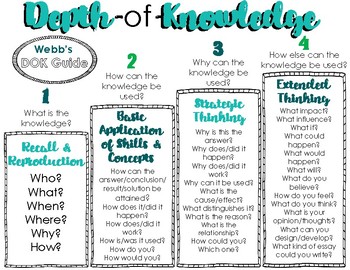
This week on the BLOG, I want to share some resources about Webb's Depth of Knowledge.  With our focus on student learning and the narrowing of what we want to hit the hardest this year, digging deeper into a text becomes even more important.  

What is Depth of Knowledge? 
DOK is the depth of understanding required to answer or explain an assessment item or classroom activity. 

Below is a great video to get you thinking about Depth of Knowledge and the classroom! 
 (Note the video states that DOK isn't just for upper grades!) 

Explicitly teaching students the different DOK levels and asking them to think at certain levels is essential.  When students can identify at what level they are thinking you can determine at what level they are understanding the curriculum. 

I love this graphic on DOK!  There are provided activity ideas under the DOK wheel to support DOK in the classroom.  Just click to download. 
Another great infographic is from the Global Digital Citizen Foundation.  
Here are some great examples of what questioning could look like in small group reading in all content areas! (I know it says third but check it out.  This link will really get you thinking!)
Howes in the Middle has a great poster to use in the classroom that explains the levels.  
Mrs. Vanmeter also supplies us with a FREE DOK anchor chart to use in the classroom!
Another thing I love about using DOK in the classroom is that it crosses all subject areas.  
Check out this infographic for DOK in math!
How are you using DOK in the classroom?


photo signature.png

Thursday, January 14, 2021

Engaging Learners

Hi All! This week on the blog, I wanted to give you some strategies to help engage your learners.  I know that this has been a struggle due to the virtual world.  

What is Learner Engagement?  In a nutshell, Learner Engagement is the measure of a potentially successful learning experience for everyone concerned. It measures the quantity and the quality of a learner's participation. It also takes in account the interaction with co learners & instructors.  

What does an engaged learner look like?
  • Active in their Learning
  • Eager to Participate
  • Willing to Expend Effort
  • Motivated
  • Inspired
I like this simple video about student engagement and the framework it explains. 

There are 3 levels of engagement:
  1. Cognitive:Taking an active, committed approach to coming up with learning strategies. Such as mnemonics to remember content. 
  2. Emotional:Feel connected to the material and or group.  Low levels of anxiety.
  3. Behavioral: Completed tasks and always show up for lessons.  
So, we have learned quite a bit about learner engagement.  Let's jump into some ideas that will help you up the engagement in your classroom. 

Learning Targets: In our January 4th PD, on the Science of Reading, our speaker expressed that setting and POSTING learning targets for your students is sooo important.  Those posting should be in the classroom not just digitally. I have always found that if we review a learning target and have it posted, it sets the WHY for the lesson.  Want it to be more powerful????? Have a student come up front and read the target at the beginning of each lesson!

Be Creative with Content: You know the standard that we are working on.  Get creative in how you deliver it.  Ask students to weigh in on what interests them.  Get that SCIENCE and SOCIAL STUDIES going in your lessons. Nonfiction is a GREAT way to up engagement and if the students have some ownership in what they will be learning about you can double on that engagement.  Use a survey about the next animal you will learn about for example. 
Hit lots of learning styles during your lessons. Add visual, music and movement to your lessons. 

Reward Learners:  This is always touchy for me.  I only want to reward extraordinary behavior not behavior that is expected.  But if this is an area that is really holding your students back, I always like earning a group reward.  Meaning building toward something.  Or adding in a bit of competition such as Cohorts competing for all assignments turned in. In PLCs, this week, I heard some great examples of earning raffle tickets for a class store and even giant Pixie Sticks. We all know that we are not in a normal situation and with that, we may need to do things we would not normally do.  This video is a JACKPOT of ideas for rewarding your kiddos! 
Check out these FREE rewards below!

Whole Brain Teaching: Get that call and response going! Even in the virtual world! Check out this video below modeling the SCOREBOARD!  I love to use this as a way to earn a "reward!" 
Here it is in a third grade classroom. 

One of my favorite blogs, Cult of Pedagogy, has a great post about engagement!  Read it by clicking the image below!

Another great one from Cult of Pedagogy.  This is defiantly one to think about! 
Next steps from ENGAGEMENT to EMPOWERMENT!  GOALS!


photo signature.png

Thursday, January 7, 2021

Numbered Heads

Hi All!  This week on the blog,  I wanted to share a Cooperative Learning strategy called Talking HEADS!  I was reminded of this training during Routines for Reasoning from our January 4th PD. 

At this point, we are working with very small numbers in our classroom so this strategy can be used as a whole class activity.  (When we are back to normal, we can use it in small groups.)

One thing I love about this strategy is that it holds ALL students accountable for learning the material.  Also, that it can be used in ALL subject areas. 

Here is how it works:
  • Students are placed in groups and then numbered off.  (If there are 4 in the group, number from 1-4.)  
  • The teacher then poses a question such as a word problem or comprehension question.  
  • Students then put their heads together to figure out the answer. (I am thinking 6 feet and just some conversation at this point.) 
  • The teacher then calls out a specific number as the spokesperson.  
  • Because no one knows which number will be called, they all must learn the information! 

Check it out in action below! 

How can this help our students?
  • Cooperative learning promotes discussion and accountability.  
  • It is great for reviewing and integrating skills.  
  • Think Practice, Rehearsal and Discussion. 
  • When students work in a group,  they take a greater responsibility for their own learning and learn from each other too! 
I love the idea of stretching the student's thinking by first starting with factual information but then moving to more open ended questioning. 

Like asking students if our school should serve pizza everyday and why?
*Students would be asked to come to an agreement and prove their thinking. 

Using this strategy with the point of view of an author would be awesome!  


Or with one of our word problems in math!


How fun is this!!!!!  Grab this freebie to add to your lessons next week! 


photo signature.png